
Food Safety and Hygiene in Industrial Kitchens

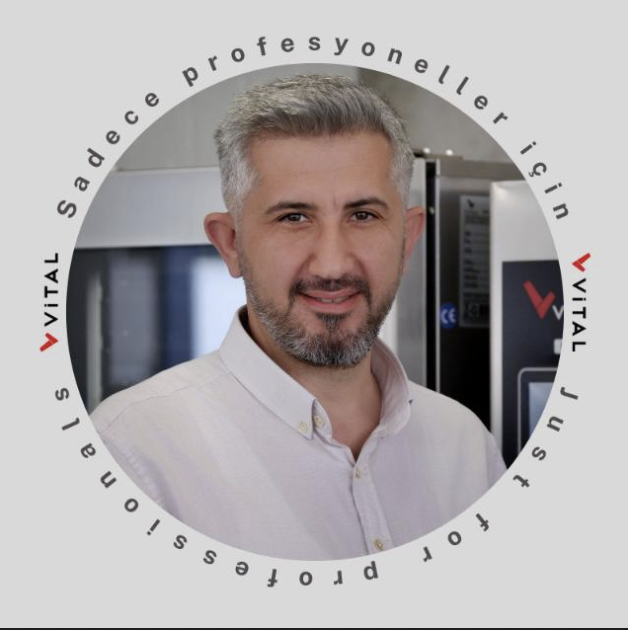
Hüseyin OYANIK
R&D Unit Responsible
Hygiene and food safety in industrial kitchens
It is as critical a factor as the taste a business offers. Because a single hygiene violation can lead to loss of customers, damage to reputation and serious legal sanctions. For this reason, process management, equipment quality and staff training are vital in professional kitchens. In this context, we talked to Hüseyin Oyanık, Vital Mutfak R&D Responsible, about how food safety can be ensured in industrial kitchens and how choosing the right equipment provides advantages to businesses.
Why has food safety become such a critical issue today?
Food safety is a process that aims to eliminate physical, chemical and biological risks at all stages from production to service. Most foodborne illnesses are caused by improper storage, inadequate cooking or cross-contamination. These risks are greater in professional kitchens because the volume of processing is high, there are many points of contact and time pressure.
A hygiene breach is not just a health issue for a business.
At the same time;
– Legal sanctions
– Risk of business closure
– Damage to brand reputation
– Loss of customers
– Decline in staff motivation
can lead to serious consequences. Therefore, food safety is the heart of a kitchen.
What are the basic hygiene measures to be taken in industrial kitchens?
Food safety is not a one-off, but a process that needs to be followed continuously. Five main topics are critical in this process:
1. Personnel Hygiene
Personnel hygiene trainings should be held regularly, HACCP principles should be taught and health checks should not be interrupted. Practices such as bonnets, gloves and clean clothes provide invisible but great protection.
2. Prevention of Cross Contamination
This is one of the most common causes of food poisoning. We strongly recommend color-coded equipment and separate preparation areas. It is unacceptable to prepare meat, vegetables, fish and baked goods on a single surface.
3. Temperature Control and Cold Chain Management
5°C-63°C is the “dangerous temperature zone”. Keeping food in this range for long periods of time invites bacterial growth.
Therefore:
– Powerful refrigeration equipment for storage,
– Devices to monitor accurate cooking temperatures,
– Blast chillers for rapid cooling of baked goods
are critical.
4. Cleaning and Sanitation
Hygiene is not possible without stainless steel on all surfaces, regular disinfection, proper use of detergents and a strong dishwashing infrastructure.
5. Pest Control
The facility should be regularly sprayed, entry points should be closed and waste management should be done correctly.
As Vital Mutfak, what kind of technology and product approach do you take to food safety?
For us, food safety is not a matter of selling equipment; it is a matter of holistic kitchen engineering.
For this reason, all the products we develop are hygiene-oriented:
– Our Stainless Steel Production Standards; All our countertops, cabinets and preparation equipment are made of 304 quality stainless steel in accordance with food regulations. This material does not harbor bacteria, is easy to clean and long-lasting.
– Cooling Systems; Our industrial refrigerators, freezers and cold rooms ensure that the cold chain is not interrupted while maintaining energy efficiency.
– Professional Dishwashing Solutions; Our guillotine and conveyor dishwashers guarantee sterilization by washing and rinsing at high temperature. This is a great advantage, especially for hotels and restaurants.
– Project Design Service; Designing the right workflow that improves hygiene is a key part of our R&D approach.
We design the kitchen flow with an engineering perspective that prevents cross-contamination, increases production speed and improves staff productivity.
Why should businesses seek professional kitchen engineering support?
Because food safety does not only depend on personnel hygiene or kitchen cleanliness. Hygiene standards are not sustainable without the right choice of equipment, the right planning and the right workflow. The most valuable thing for a business is its reputation. The way to protect this reputation is to establish a kitchen infrastructure that eliminates risks.
That’s why, as Vital Mutfak, we develop solutions for businesses not only for today but also for their long-term operational safety.
Finally, what advice would you give to businesses on improving food safety?
Every business should never neglect these three points:
1. Right equipment
2. Right training
3. Right workflow design
If these three are met, food safety is no longer a challenge, it becomes a natural routine of the business. As Vital Mutfak, we strive to support businesses in this process with all our products and consultancy services.